
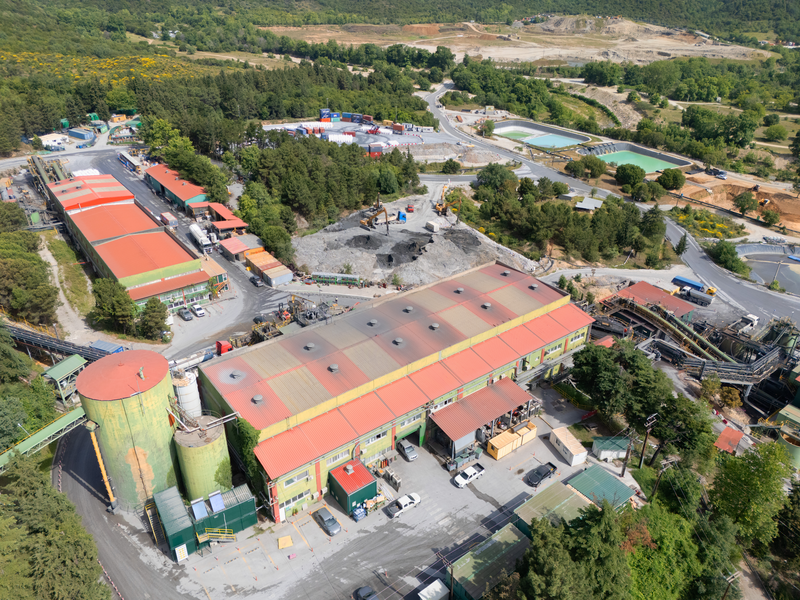
Advancing Geological Understanding: An Interview with Spyros Fragkou
We recently sat down with Spyros Fragkou, a PhD candidate at the University of British Columbia (UBC) and a former student intern with Eldorado Gold, to discuss his research on the Olympias deposit in Halkidiki, Northern Greece. Spyros’s research bridges academic innovation and practical exploration, offering new perspectives on mineral deposits and the future of mining in the region.
“Spyros’s research at Olympias is deepening our understanding of the mineral system, and his work with our Mine and Exploration Geologists is testament to the value and shared interests of academia-industry collaboration. This is a great example of how rigorous and detailed geoscience can support company objectives of resource addition and discovery of new mineralized zones," said Claire Chamberlain, VP Exploration. "Beyond his research, Spyros’s internship was providing him with an insight into the practicalities and business of exploration – through supporting our Corporate exploration team in undertaking compilations of maps and historic data, and also in creating interpretation maps that have been used in presentations to our senior leadership team and Board to illustrate the strategic importance of advancing geological understanding across our portfolio.”
Exploring the Olympias Deposit: A natural laboratory
Spyros’s PhD research centers on the Olympias carbonate replacement deposit, owned by Eldorado Gold. Using Olympias as a “natural laboratory,” Spyros investigates how hydrothermal fluids move through marble horizons, the geological controls on massive sulfide replacement, and the processes behind the deposit’s exceptional gold enrichment. His approach combines fieldwork in Halkidiki with advanced analytical methods, including innovative tools like shortwave UV light to identify cryptic alteration features—hidden clues that can point toward new mineralization and ore bodies.
This research is more than academic: it refines the genetic model of Olympias, improves predictions for new ore bodies, and guides exploration strategies for Eldorado Gold across the Kassandra mining district.
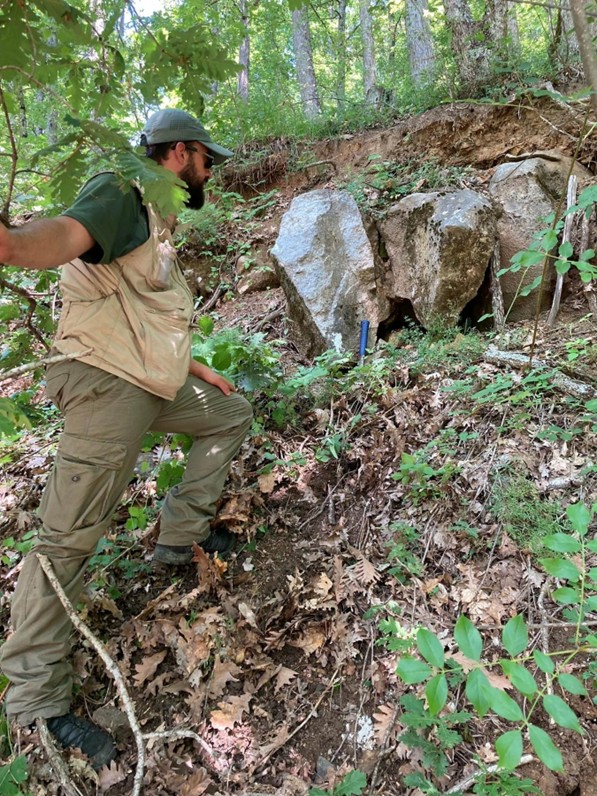
Spyros collecting rock samples from marble outcrops around Olympias deposit for his research.
Bridging continents: From Greece to Canada
Spyros’s journey began in Greece, where a visit to the Olympias mine during his undergraduate studies sparked his passion for economic geology. Pursuing his PhD in Canada allowed him to join UBC’s Mineral Deposit Research Unit (MDRU), renowned for its industry connections and cutting-edge research. The collaborative culture and sustainability focus in Canada have shaped his approach to mining and exploration.
Maintaining strong ties to Greece, Spyros’s research is deeply personal – contributing to his home country while advancing scientific understanding of a significant mining district. The direct link between his academic work and Eldorado Gold’s active projects has shaped his research questions to deliver both scientific and practical value.
Fieldwork meets strategy: Internship insights
Over three summers, Spyros interned with Eldorado at Olympias, collecting data and samples for his PhD. This hands-on experience allowed him to apply university learning in the field, developing skills in drill core logging, mapping, sampling, and analysis. More recently, working at Eldorado’s corporate office in Vancouver gave him insight into how geological data informs exploration strategy and decision-making.
These dual perspectives—field and corporate—have helped Spyros refine his research approach and benefit from mentorship with experienced geologists. The synergy between academic research and industry practice has been essential for his growth as a geologist.
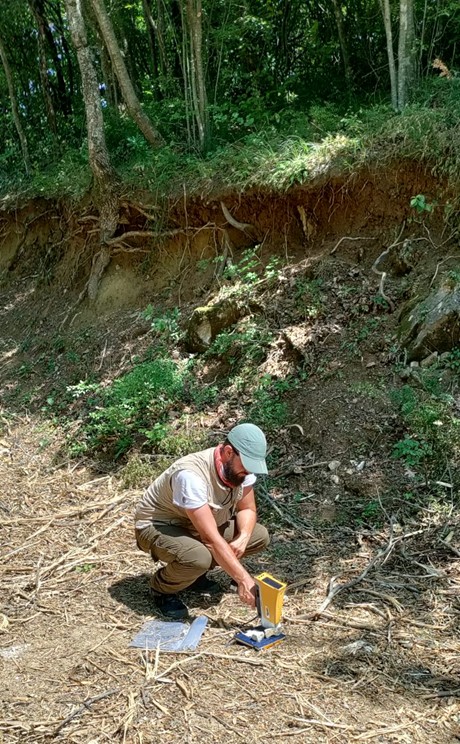
Spyros analyzing the rock samples in the field with a portable XRF instrument to assess their geochemical signature.
Opportunities and challenges in Halkidiki
Halkidiki’s geology is complex, shaped by multiple phases of magmatism, deformation, and hydrothermal activity. The region hosts diverse deposit types, from porphyry Cu–Au systems like Skouries to carbonate replacement deposits such as Olympias, as well as skarns and epithermal-style mineralization. This diversity signals strong potential for new discoveries, including deeper or “blind” systems that may be revealed through advances in geophysics and geochemistry.
However, the same complexity presents challenges: multiple geological units, overlapping deformation phases, and successive hydrothermal pulses make it difficult to reconstruct ore-forming events and predict deposit continuity. Dense vegetation and limited outcrop exposure further complicate exploration efforts. Success in Halkidiki will depend on innovative approaches and detailed geological mapping.
Looking ahead: Science and industry in harmony
Spyros sees his academic background and industry experience as complementary forces. Rigorous research has honed his critical thinking and problem-solving skills, while internships have provided practical expertise and strategic perspective. He aims to continue working in mineral exploration, combining scientific innovation with industry realities to drive sustainable resource development.
Conclusion
Spyros Fragkou’s journey exemplifies the value of integrating academic research with industry practice. His research not only advances geological understanding but also supports Eldorado Gold’s exploration strategies in one of Europe’s most promising mining districts. We look forward to seeing how his insights continue to shape the future of mineral exploration.